Learn what makes a good Turnitin similarity score, how to interpret your report, and what percentages actually mean for your academic integrity.
What Is a Good Turnitin Similarity Score? A Straightforward Guide
You just uploaded your paper. Your heart beats faster while the Turnitin similarity report checker processes your document. Then you see it: a bright yellow box showing 18% similarity. Your stomach drops. You start wondering if your professor will accuse you of plagiarism, or if you need to rewrite everything at 2 AM before the deadline.
Take a breath. That percentage number tells only part of the story. If you want to know what is a good Turnitin similarity score, you need to look past the raw percentage and understand what the software actually measures. Most students and even some instructors misunderstand what these numbers represent. They treat Turnitin like a plagiarism detector when it functions more like a text-matching tool.
What Does Turnitin Score Mean?
First, you need to understand what does Turnitin score mean in practical terms. Turnitin compares your submitted text against billions of web pages, academic journals, books, and previously submitted student papers. When it finds matching text, it highlights that content and calculates what percentage of your total document matches existing sources.
Here is the critical part: Turnitin does not determine whether you plagiarized. It simply flags similarities. Your professor makes the final judgment about academic integrity based on the context of those matches. A high percentage might indicate excellent research with proper citations. A low percentage might indicate you avoided using sources entirely or tried to game the system.
The similarity score represents the percentage of your document that matches text in the Turnitin database. If you submit a 1,000-word essay and Turnitin reports 15% similarity, that means roughly 150 words match existing sources somewhere in their database. Those words could come from legitimate quotations, your reference list, common phrases, or unfortunately, uncited text.
Is 10% Bad on Turnitin?
Let us address the specific question: is 10% bad on Turnitin? Short answer: absolutely not. In fact, most academics consider 10% or below excellent. A score in this range typically indicates strong original writing with minimal text matching.
However, context matters more than the number itself. A 10% similarity score composed entirely of one long paragraph copied from Wikipedia without citation raises red flags. The same percentage spread across multiple properly quoted sources with citations represents good academic practice.
Universities generally view scores between 0% and 10% as safe territory. Your work demonstrates original thought while engaging appropriately with source material. Do not obsess over hitting exactly 0%. Some similarity often proves you conducted research and incorporated existing scholarship into your argument.
20% Similarity on Turnitin: Understanding the Yellow Zone
Now consider 20% similarity on Turnitin. This sits in the middle range where many students panic unnecessarily. The color coding in Turnitin similarity reports typically shows green for scores under 25% at many institutions, though some systems use different thresholds.
A 20% score demands attention but not necessarily alarm. You might see this percentage if you:
- Used several direct quotations from primary sources
- Included technical terminology standard in your field
- Submitted work with a cover sheet or template provided by your instructor
- Wrote about a common topic with limited phrasing options
Review the breakdown. Turnitin shows you exactly which sources match your text. If most matches come from properly cited quotations or your bibliography, your score reflects normal academic writing. If matches cluster in specific paragraphs without citations, you need to revise those sections.
Average Similarity Score on Turnitin
Students often ask about the average similarity score on Turnitin they should expect. Research and university guidelines suggest most undergraduate papers fall between 15% and 25% similarity. Graduate-level work often shows slightly lower percentages because advanced students typically paraphrase more effectively.
Different assignment types produce different averages:
- Literature reviews: 25-40% (heavy quotation expected)
- Research papers: 15-25%
- Reflective essays: 5-15%
- Lab reports: 10-20%
- Creative writing: 0-5%
These ranges represent observations, not rules. Your institution might have specific policies. Some universities consider anything above 15% unacceptable; others tolerate up to 30% if properly cited. Check your student handbook or ask your instructor directly about expectations.
Turnitin Similarity Report Good Score by Assignment Type
When evaluating whether you achieved a Turnitin similarity report good score, consider your specific assignment requirements. A good score for a literature review differs dramatically from a good score for a personal reflection essay.
For assignments requiring heavy source integration like systematic reviews or theoretical analyses, scores between 20% and 35% might prove completely acceptable. You need to quote existing research extensively to build your argument. Your instructor expects this.
For opinion pieces, creative writing, or personal statements, you want much lower numbers. Scores above 10% in these contexts suggest either excessive quotation or potential originality issues. Original analysis should dominate these assignments.
Technical and scientific writing presents unique challenges. Standardized terminology, chemical compound names, and methodological descriptions cannot be paraphrased without creating confusion. These necessary matches often push similarity scores higher despite complete originality of thought.
Turnitin Similarity Score Meaning: Reading the Colors
The Turnitin similarity score meaning extends beyond percentages into color coding. When you view your report, you see colored boxes indicating similarity levels:
- Blue: No matching text found
- Green: 1-24% matching text
- Yellow: 25-49% matching text
- Orange: 50-74% matching text
- Red: 75-100% matching text
Do not assume green means good and red means bad. A blue score of 0% might indicate you failed to include any research. A red score of 100% might mean you resubmitted your own work from a previous draft, which many instructors allow.
The colors simply organize papers for review efficiency. Instructors prioritize reviewing yellow, orange, and red submissions, but they must examine the actual matches to determine significance.
Good Turnitin Score Meaning for Academic Integrity
Understanding good Turnitin score meaning requires shifting your mindset from chasing low numbers to pursuing academic integrity. The best score demonstrates you:
- Engaged deeply with source material
- Paraphrased effectively rather than changing a few words
- Cited all borrowed ideas and quotations properly
- Developed original arguments supported by evidence
A perfect 0% often raises suspicions. Did you avoid reading any existing research? Did you use AI tools to generate text that avoids matching detection? Did you employ text replacement tricks like swapping characters or using hidden text? Instructors watch for these manipulation attempts.
Conversely, a 30% score with every match properly attributed to cited sources demonstrates exemplary academic practice. You synthesized existing scholarship effectively.
How to Check Your Turnitin Similarity Report Checker Results
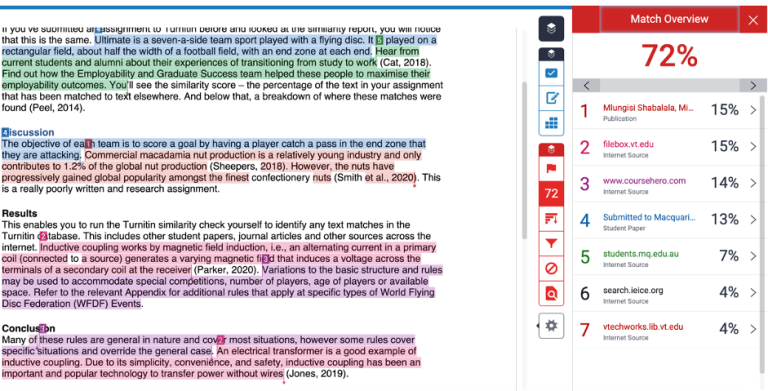
When you access the Turnitin similarity report checker interface, look beyond the headline percentage. Click into the match breakdown to see:
- Which specific sources match your text
- How much text matches each source
- Whether matches cluster in particular sections
- If quotations appear properly formatted
Use the filter options. Exclude your bibliography and properly formatted quotations. See how your score changes. This filtered view often reveals your true similarity more accurately, since reference lists should match standard formats.
Check for matches to your own previous submissions. If you wrote a related paper last semester and expand on those ideas, Turnitin flags this as self-matching. Most instructors allow this if you declare it, but the raw percentage looks alarming.
What Influences Your Similarity Score?
Several factors push your percentage up or down regardless of writing quality:
Bibliography inclusion: Reference lists typically match 5-10% against citation databases. Excluding these reduces your score appropriately.
Assignment templates: If your instructor provided a cover sheet or structure, every student submits similar headings and instructions. This generates false matches.
Common phrases: Standard academic transitions like “In conclusion” or “Furthermore” match thousands of papers. These single-word or short-phrase matches inflate scores insignificantly.
Technical terminology: Discipline-specific terms cannot be paraphrased. A biology paper discussing “photosynthesis” or “mitochondrial DNA” will match other papers discussing the same concepts.
Quotation practices: Some fields value extensive direct quotation; others discourage it. History papers often quote primary sources heavily; psychology papers rarely do.
When High Scores Signal Problems
Certain patterns in Turnitin reports indicate genuine concerns:
Single-source matches: If 40% of your paper matches one website or one other student paper, you likely copied extensively. Even with citation, excessive reliance on one source suggests weak research.
Block matches: Continuous matching text spanning multiple paragraphs indicates copied sections rather than incidental similarities.
No quotation marks: Matching text presented as your own words without citation constitutes plagiarism regardless of percentage.
Wikipedia clusters: Heavy matching to encyclopedia entries rather than academic sources suggests lazy research practices.
How to Lower Your Similarity Score Legitimately
If your percentage runs higher than your instructor allows, improve your writing rather than manipulating text:
Paraphrase deeply: Read the source, close it, write your understanding in your own words, then check against the original. Change sentence structure and vocabulary while preserving accuracy.
Reduce quotation density: Quote only when the exact wording matters. Paraphrase background information and general arguments.
Cite properly: Ensure every borrowed idea has attribution. Proper citation does not lower your similarity score immediately, but it demonstrates integrity.
Synthesize multiple sources: Instead of summarizing one source per paragraph, combine insights from several sources with your own analysis.
Check drafts early: Submit to Turnitin before your final deadline if your institution offers draft checking. Review the report and revise problematic sections.
When Similarity Scores Do Not Matter
Sometimes you can ignore the percentage entirely:
- Your instructor explicitly states they evaluate reports individually regardless of score
- You used a provided template that generates high baseline similarity
- You are resubmitting your own revised work with instructor permission
- Your assignment requires extensive quotation of legal documents, literature, or historical texts
- You included large data tables or standardized methodologies that must match exactly
Final Thoughts
There is no magic number that guarantees academic success. A good Turnitin similarity score reflects that you wrote originally, cited properly, and engaged honestly with your sources. Stop chasing 0%. Stop panicking at 25%. Instead, examine your report details, fix actual problems, and submit work that represents your genuine intellectual effort.
Your goal is not to fool the algorithm. Your goal is to contribute something meaningful to academic conversation while giving credit to those who informed your thinking. Master that balance, and your similarity score becomes just another data point rather than a source of anxiety.
LET US HUMANIZE YOUR PAPERS – No Plagiarism Guarantee!
Need assistance with your writing? Look no further! Our team of skilled writers is prepared to provide you with prompt writing help. Rest assured, your work will be entirely original and free from any plagiarism, as we offer a guarantee against it. Experience swift and dependable writing assistance by reaching out to us today!
Top-Rated AI Text Humanizer | GET Flawless content for All Your PROJECTS!