Worried about your Turnitin report? Learn if 25% similarity is bad, how to interpret different percentages, and what score is actually safe for your essay.
Is 25% similarity on Turnitin bad?
If you just submitted your paper and saw a big yellow icon with the number 25 next to it, you probably feel a bit of a sting. You want to know if 25% similarity on Turnitin is bad, and the honest answer is that it depends. For some professors, 25% is the exact moment they start looking closer at your work. For others, it is a perfectly normal number for a research heavy assignment.
Turnitin uses a color coding system to help instructors quickly scan through submissions. When your score hits 25%, the icon changes from green to yellow. This shift often triggers a manual review. Is 25% plagiarism bad? Not necessarily. Similarity is not the same thing as plagiarism. A similarity score just tells the reader how much of your text matches other sources in the Turnitin database. Plagiarism is when you take those matches and try to pass them off as your own thoughts without giving credit.
You might have a 25% score because you used several long, perfectly cited quotes. In that case, you are likely safe. However, if that 25% comes from one single block of text that you copied and pasted from a website, you have a problem. Context is everything when you are dealing with these numbers.
Is a Turnitin similarity score Bad?
Many students panic the moment they see any number higher than zero. But is a Turnitin similarity score bad just because it exists? Usually, no. In fact, a 0% score can sometimes look more suspicious than a 15% score. A 0% match suggests you didn’t use any outside research, or perhaps you tried to trick the software by using special characters or hidden text.
Academic writing is built on the ideas of others. You are expected to cite sources, use data, and reference previous studies. All of these actions will naturally raise your similarity percentage. The goal isn’t to hit zero; the goal is to make certain that every match is properly explained and credited.
How Turnitin generates your report
When you upload a file, the software breaks your text into small strings of words. It then compares these strings against billions of web pages, archived content, journals, and millions of other student papers. If it finds a match, it highlights the text and adds it to your total percentage. The software does not know if you cited the source. It only knows that the words are the same. This is why a human must always look at the report to decide if the similarity is actually a problem.
What percentage of similarity is acceptable in Turnitin?
Every university and every department has its own rules. There is no universal number that applies to every student in every country. If you are wondering what percentage of similarity is acceptable in Turnitin, you should first check your course handbook or ask your lecturer.
Generally speaking, most institutions look for a score under 20% or 15%. If your score falls in this range, it usually suggests that you have done your own work while referencing others in a standard way. However, if your assignment involves a lot of technical terms, legal citations, or a specific template provided by your school, your score might naturally be higher.
Acceptable ranges by subject
The subject you are studying changes what counts as a good or bad Turnitin percentage.
- Law and Medicine: These subjects often have higher scores because they require exact legal statutes or medical terminology that cannot be paraphrased. A score of 25% or 30% might be normal here.
- Creative Writing: Since the work should be entirely original, a score over 5% or 10% might raise eyebrows.
- STEM Fields: Lab reports often use the same methodology descriptions, which can drive up similarity scores across a whole class.
What is a good plagiarism score for Turnitin?
When people ask about a good plagiarism score for Turnitin, they are usually looking for a safe zone. A good score is typically anything between 1% and 15%. This shows that you are engaging with the literature but still providing plenty of your own analysis.
If you are aiming for a specific number, try to stay in the “Green” zone, which is anything below 25%. Once you hit the “Yellow” zone (25% to 49%), the software is signaling to your professor that a large chunk of your paper is not original wording.
Breaking down the percentages
To give you a better idea of where you stand, let’s look at specific numbers that students often worry about.
- Is 10% on Turnitin bad? Almost never. This is a very safe score that shows a healthy balance of original thought and minimal referencing.
- Is 11% on Turnitin bad? Same as 10%. You have nothing to worry about as long as your citations are correct.
- Is 24% on Turnitin bad? You are right on the edge of the green zone. It is not “bad,” but you should check the report to make certain you aren’t relying too heavily on one single source.
- Is 30 on Turnitin bad? At 30%, you are firmly in the yellow zone. This is often where instructors start to get concerned. You should look at your report and see if you can paraphrase some of the highlighted sections.
- Is 36% on Turnitin bad? Yes, this is usually considered high for a standard essay. It suggests that more than a third of your paper matches other sources. You likely need to do more original analysis and less quoting.
is 25% plagiarism bad
It is important to separate the word “similarity” from “plagiarism.” If you see a 25% match, don’t immediately think you have 25% plagiarism. Plagiarism is a serious academic offense that can lead to failing a grade or even expulsion. Similarity is just a data point.
Is 25% plagiarism bad? If that 25% represents uncredited work, it is very bad. But if that 25% is made up of a 10% bibliography, 5% common phrases, and 10% properly cited quotes, then you haven’t committed plagiarism at all. The software is just doing its job by finding those matches.
When 25% becomes a problem
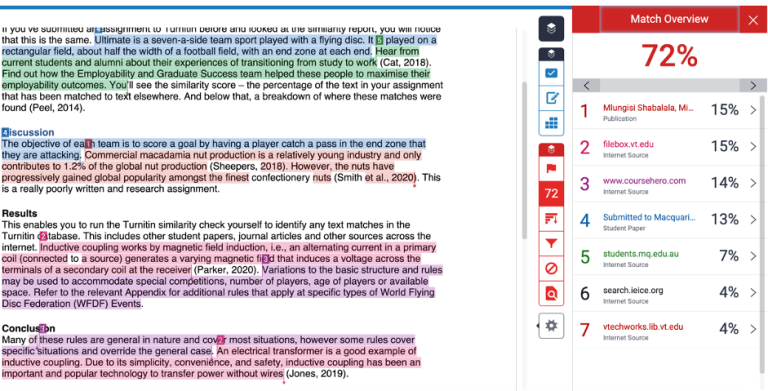
The real danger is when a large percentage comes from a single source. Turnitin provides a “Match Overview” that lists sources by percentage. If your overall score is 25%, but one specific website accounts for 20% of that, your professor will see that you basically copied a large portion of your paper from one place. This is often called “patchwork plagiarism.”
Turnitin 25% vs lower scores
When we look at Turnitin 25% vs a score like 12%, the difference is usually the depth of your own voice. A 12% score typically means the student has taken an idea, digested it, and written it in their own words. A 25% score often means the student is leaning on the original author’s wording a bit too much.
Think of it like a conversation. If you spend 25% of the time repeating exactly what someone else said, people might wonder if you have your own opinion. If you only repeat 10% and spend the rest of the time explaining why it matters, you look like an expert.
| Similarity Range | Color | Typical Meaning | Action Needed |
| 0% | Blue | No matches | Check if the file uploaded correctly. |
| 1% – 24% | Green | Low similarity | Usually safe; check citations. |
| 25% – 49% | Yellow | Moderate similarity | Review for over-quoting or poor paraphrasing. |
| 50% – 74% | Orange | High similarity | High risk; likely needs a total rewrite. |
| 75% – 100% | Red | Very high similarity | Serious problem; likely total plagiarism. |
Can a student view a Turnitin score?
Many students want to check their work before the final deadline. Can a student view a Turnitin score? Yes, but only if your instructor has enabled that feature. Some professors allow students to see their similarity reports and resubmit their work as many times as they want until the due date. This is a great way to learn how to paraphrase better.
If your school doesn’t allow you to see the score, you might have to rely on third party tools or simply be very careful with your notes. Always check your university portal to see if the “Similarity Report” icon is clickable. If it is greyed out, it means your teacher has restricted access.
Why your score might be high (without cheating)
Sometimes you do everything right and still end up with a high number. There are several factors that can artificially inflate your score.
The role of the bibliography
Your reference list is a list of titles, authors, and dates. Thousands of other students have used those same sources. Turnitin will highlight almost every line of your bibliography because it matches other papers. This can easily add 5% or 10% to your total score. Most instructors know how to filter this out, so don’t let a highlighted reference list scare you.
Common phrases and templates
In some assignments, you are required to use a specific cover page or answer specific questions. If 200 other students are using the same cover page, Turnitin will flag that entire page as a match. Similarly, common academic phrases like “The purpose of this study is to…” or “According to the results of the experiment…” are flagged because they appear in millions of papers.
Self plagiarism
If you have submitted a paper to Turnitin in the past, even for a different class or a different school, the system remembers it. If you reuse a large part of your old work, Turnitin will flag it as a 100% match. This is known as self plagiarism, and many universities treat it just as seriously as regular plagiarism. Always check with your instructor before reusing your own previous work.
Practical tips to lower your similarity
If you find yourself stuck with a score that feels too high, there are several ways to fix it without starting from scratch.
- Paraphrase properly: Don’t just change every third word or use a thesaurus to find synonyms. Read the paragraph, look away, and then explain the concept out loud. Write down what you said. This is the best way to get a unique sentence structure.
- Use quotes sparingly: Only quote when the original wording is so unique or powerful that you can’t possibly say it better. For everything else, summarize the main point.
- Check your citations: Make certain every match has a name and a year attached to it. If the text is highlighted but there is no citation nearby, you are in the danger zone.
- Exclude small matches: If your instructor allows you to see the report, look for the filter icon. You can often exclude matches that are less than 5 words or 1% of the paper. This removes the “noise” of common phrases and gives you a more accurate picture of your original work.
Looking beyond the number
At the end of the day, a Turnitin score is just a tool. It is an invitation to look closer at your writing habits. If you have a 25% score, take a deep breath. Open the report and look at the highlighted sections. Are they your words? Are they properly cited? If you can honestly answer “yes,” then you are likely in a good spot.
Focus on building a strong argument and supporting it with evidence. If you do that, the numbers will usually take care of themselves. Your professor wants to see your thoughts, your analysis, and your voice. As long as those elements shine through, a yellow icon won’t be the end of your academic career.
LET US HUMANIZE YOUR PAPERS – No Plagiarism Guarantee!
Need assistance with your writing? Look no further! Our team of skilled writers is prepared to provide you with prompt writing help. Rest assured, your work will be entirely original and free from any plagiarism, as we offer a guarantee against it. Experience swift and dependable writing assistance by reaching out to us today!
Top-Rated AI Text Humanizer | GET Flawless content for All Your PROJECTS!